

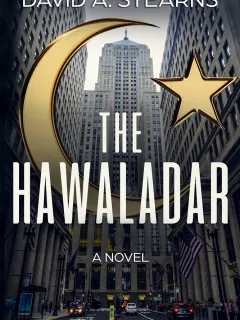
The Hawaladar
David A. Stearns · Completed · 187.1k Words


Introduction
Chapter 1
PROLOGUE
ITS ALLEYWAYS teeming from dawn until dusk with locals and tourists alike, the sights, sounds, and scents of the Raja Bazaar of Rawalpindi, Pakistan are all intoxicating. The Raja has long been one of the more popular shopping destinations for individuals looking for a more historic change-of-pace to the immediately adjacent—and significantly more modern—capital city of Islamabad. The always vibrant market is well-known as the place to go in the
Old City
when one wants to experience the flavor of doing business in a manner traditional to south Asia. Hyper-vigilance should be the rule of the day for any visitor, however. Not all who frequent the Raja are of the most desirable character.
This atmosphere of foreboding explained in great part the rather audible sigh of relief emanating from the tall, distinguished-looking Pakistani businessman as he entered the large, double front doors of Nasir Jewelers, one of the more prominent of the many dealers in precious metals and high quality, handmade jewelry located in the Raja. Nasir Jewelers had an international reputation for the quality and design of their workmanship, but they were perhaps better known for being purveyors of certain other very special services.
“Ah, Yafai al-Kassem, my excellent friend,” gushed Salim Wajihuddin. Almost obnoxiously solicitous of anyone he deemed important, Wajihuddin was the highly regarded manager of the store considered by most to be the flagship location of the nation-wide Nasir jewelry and precious metals chain. “
Massah al-khair
—good afternoon,” effused the shopkeeper as he embraced the rugged-looking al-Kassem with a relaxed familiarity reserved for only his most preferred of recurring clients. Respectfully kissing his customer lightly on both cheeks, Wajihuddin steered him toward a small table to the rear of the store. “Please, please be seated dear brother and partake of some tea with me.”
“Uh, yes—
massah al-noor
—the same to you, Mr. Wajihuddin,” replied the noticeably much relieved al-Kassem as he seated himself next to a small, round table covered with a nicely pressed white linen tablecloth. Considering the large amount of cash on his person, the ring of the bell affixed to Nasir Jewelers’ large front door had been a welcoming sound to al-Kassem. “It is good to see you again as well, but unfortunately, as much as I thank you wholeheartedly for your usual, gracious hospitality, I will regrettably only have time for one quick glass of your wonderful tea today.” Al-Kassem needed to transact his business with the cagey old jeweler as quickly as he could and be on his way, but he would have to accept at least one sip of the shopkeeper’s steaming brew. In Pashtun culture, to do otherwise might easily be perceived an egregious insult. “I have pressing matters that must yet be tended to back home in Peshawar this evening if I am able to finish my business with you soon enough to catch a timely return flight.”
Yafai al-Kassem, was a much-revered elder of the Afridi tribe of northern Pakistan who had become a relatively wealthy man through many years of successful trading in new and used vehicles to the Pashtun tribesmen, Taliban militants, foreign terrorists and myriad other groups of individuals populating the Hindu Kush—the mountainous region bordering Pakistan and Afghanistan, where the Indian subcontinent and central Asia converge. Every three months for the past twenty years, al-Kassem had regularly traveled from his home in Peshawar—the ancient city that sits at the eastern entrance to the fabled Khyber Pass—to Islamabad, some 170 kilometers away, where he always attended a big auction at one of the largest vehicle marts in the country.
The seemingly endless conflict of the region surrounding Peshawar was an economically unfortunate fact-of-life for many who called that part of Pakistan home, but not for al-Kassem. He was a survivor. Where most merchants in the historically war torn area struggled simply to remain in business, the wily vehicle trader flourished, finding numerous ways of doing business with the disparate factions perpetually fighting for control there. If anything, the region’s turmoil more often than not precipitated situations that accelerated the need for people to replace their vehicles. Regular treks to Islamabad to replenish his rapid-turning inventory of cars and trucks were thus essential to al-Kassem’s business. His reason for visiting the upscale jewelry merchant today, however, had little to do with the buying and selling of vehicles.
“By all means, my friend, by all means,” responded the shopkeeper as he filled two small glasses of steaming green tea from an ancient-looking brass samovar. “I am disappointed we cannot visit longer, but I understand. I always do so look forward to our conversations though. May I presume you’re here to once more avail yourself of our financial services?”
“That’s correct. I need to send money to my son in Germany again.”
“More support for the budding engineer, heh? He fares well with his studies, I trust?”
“Yes! Yes, he does, but the cost of tuition and fees, room and board, and books seems to increase with frustrating regularity.”
“Well, I have never experienced your plight, my friend. Alas,
Allah
—may he be praised forever—has never blessed me with children. Yet, I can readily believe what you say is true.” The balding, bespectacled, old jeweler grinned and shook his head sympathetically. “Same instructions for delivery as before, I would presume, Hamburg, Germany at our earliest opportunity?”
“Right, but this time, I need to transfer the equivalent of ten thousand Euros instead of our usual five.”
“My, that is an increase, my friend. It indeed appears to be a big commitment for one’s children to study abroad. Does it not?” Wajihuddin wished he had more occasions to handle transfers like those that al-Kaseem regularly transacted through him between Rawalpindi and Germany. The volatile exchange rate between Euros and Pakistan Rupees accorded the old merchant frequent opportunity to augment the usual one and one-half to two percent fees he charged for this type of transfer with an additional profit. Punching some numbers into a laptop computer sitting on his customer counter, Wajihuddin’s brow furrowed as part of a much-practiced look of resignation. “Hmm, let me apologize in advance, my friend, but it would seem our country’s many conflicts and upheavals during the past year have continued to greatly devalue our Rupee in the European market. We are at 168 Pakistan Rupees against the Euro today.”
“No explanations needed, Mr. Wajihuddin. I knew that would be the case and have come prepared for that.”
“Very well, my friend, I just wanted to forewarn you,” said the old money mover looking back at his computer. “However, using the figures shown here, it appears as though we will need 16.8 Lakh PKRs for the transfer and another 25,200 PKRs for our one and one-half percent fee, kind sir.
“Fine, as I said, I came prepared for that.” The heavily bearded al-Kassem reached under his Jubba, the traditional ankle length outer garment worn by many of the Pashtun tribesmen in his home area of Peshawar, and reversed the cloth belt around his waist to reveal a large pouch he had been wearing in the small of his back. Removing a sizeable stack of large-denomination Pakistani currency from the pouch, he carefully counted out the requested amount using mostly mustard-colored 5,000 PKR denomination bills, and handed them over to the expectant Wajihuddin.
By comparison, the quarterly transactions usually conducted between al-Kassem and the Islamabad auto mart he had done business with earlier that day were most always handled using conventional bank transfers. Yet, for these international transfers to his son, al-Kassem preferred to use the kind of service someone like the old jeweler provided. It was much faster, and considering the occasional failings of the Pakistani banking system, in many ways far more secure. Cash was needed to transact business in this manner, however, and al-Kassem was always nervous about having to carry around large amounts of it in some places he had to frequent on his buying trips. Life might be tenuous at best were any number of the unsavory characters he typically encountered along the way ever to find out what he was carrying. This also explained the Glock 19 in the shoulder holster beneath his Jubba—and his heavy sigh of relief upon entering the shop
Wajihuddin made a deliberate show of not recounting the money given to him in front of al-Kassem. To be sure, the amount would later be verified by machine, but in the interim everything regarding the business they were about to transact would be based on trust, an inviolable trust that neither dared breach. “And how will your son identify himself to our Hamburg associates this time, Mr. Kassem?”
“Same method as before would be fine with me.”
” Excellent!” The old merchant reached into a drawer under his customer counter, withdrawing a U.S. one-dollar bill. Tearing it equally in half, he handed the right portion to al-Kassem, pointing to the duplicate serial numbers in the upper right and lower left-hand corners of the bill. “As always, communicate the serial number on your half of this bill to your son at your earliest opportunity, Mr. Kassem. Using it, he should be able to pick up his money at just about any time from tomorrow morning on.”
“Will the place of delivery be the same as well?”
“Yes, my friend. We always use our associates at Halbmond Jewelers at Altes Steinweg 53, in downtown Hamburg, which coincidentally happens to be an affiliate of ours. As you know, most often that is not the case. Again, all your son need do to receive disbursement of the funds is to properly identify himself as the recipient by accurately reciting the serial number I have just shown you on your half of this bill.”
Nodding curtly, al-Kassem turned to leave the shop, stopping briefly at the door to thank the money mover. “
Shoo kran
, Mr. Wajihuddin,
Maa as-salaam
.”
“
Allah Yi sull mak
, Mr. Kassem. I shall look forward to your return. Perhaps you will have time to share more than one glass of tea with me next time.”
Returning to his laptop, Wajihuddin quickly typed out an e-mail message via a free, online Gmail account to his counterpart at Halbmond Jewelers in Hamburg, Germany. The amazingly truncated message was limited to simply stating the serial number he had just given to al-Kassem, followed by the amount being transferred. It was all Wajihuddin’s counterpart in Hamburg needed to know to complete their part of the transfer.
Settlement for this particular transaction would indeed be far simpler than most. As he had indicated to al-Kassem, Halbmond Jewelers in Hamburg was an affiliate of Wajihuddin’s shop in Rawalpindi, both being subsidiaries of PAK Metals, Ltd., an international company owned by the well-known and influential Nasir family of Karachi. The next shipment to Hamburg of gold jewelry designed and handcrafted by Pakistan-based Nasir artisans would be under-invoiced to provide for the appropriate credit from one profit center to the other. Even though it was an intra-company transfer, company policy still required each office to account for such transactions in the same way they would have had they been with a non-related entity, as was far more frequently the case.
◊◊◊◊
MAHMOUD NASIR, patriarch of the Nasir family and sole owner of PAK Metals, Ltd., was a devout Sunni Muslim whose ancestors had been movers of money for many generations before him. Theirs was the business of
Hawala
, the ancient form of financial service embraced by residents of South and Central Asia and parts of the Middle East since the days of the Great Prophet, Muhammad.
For centuries, members of the
Ummah
—the body of true believers constituting the whole of Islam—have relied upon the system of hawala as a way of doing business throughout the commercial worlds of their day. Transcending great distances and political boundaries through amazingly simple methods of transfer and settlement, ancient practitioners of hawala were providing a form of private banking to their clients long before such a concept was ever envisioned in the world of modern finance. Arab caravans during the time of the Great Prophet used the system to avoid robberies on the Silk Road, while other ancient societies like the Chinese with their system of
Fei Chien
or Flying Money, or Thailand with its system of
Phoe Kuan
, used similar methods to ensure the security of financial transactions within their cultures.
Engendering the trust of the people they serve by adhering to strict confidentiality and the Islamic principals of honesty and strong family relationships, providers of such services—known as
Hawaladars—
have always purposely functioned in the shadows. Yet, as many countries have begun to realize the monetary size and reach of such informal systems of value transfer, governments have instituted regulations aimed at controlling their activity. As a result, most countries have started to require the registration of all such entities—now collectively referred to as Money Service Businesses—along with the detailed reporting of nearly all transactions processed through them.
Hawala is nevertheless a system that still clings to a rigid, centuries-old culture of confidentiality. So, it is not rare to find many hawaladars around the world today who have chosen not to register, hiding their involvement in the trade behind business facades that can both mask and compliment money transfer operations, choosing instead to function outside the confining, currency-reporting laws and regulations of modern banking and finance.
Principally aiding in the transfer of money worldwide for both commercial and personal business, the methodologies used by the hawaladar have remained much the same throughout history. Only the tools and speed by which they are now able to transact business for their clients have changed. Modern technologies such as faxing, Internet communications, smart phones, and social networking have empowered their netherworld of parallel banking, while at the same time debilitating the efforts of those who would desire to regulate the type of business they transact.
Clients served by the system of hawala are predominantly small businesses and individuals, but in some instances may just as likely be governments or those involved in a multitude of nefarious activities, such as terrorism or money laundering by criminal elements. To the traditional hawaladar, the purpose of the transaction is by and large of little concern. No questions are typically asked beyond those necessary to complete the transaction at hand—and cheating is beyond comprehension. To defraud a client would not only bring on an irreversible loss of face, but possibly as well the dreaded designation of
Kafir
, or non-believer, for the offending hawaladar. Such a breach of trust would be equivalent to signing one’s own economic—or perhaps sometimes physical—death sentence.
Transactions are simple. A hawaladar in one city or country will receive cash or its fungible equivalent from a client, along with a request for the transfer of that sum to an individual in another distant location, who properly identifies his or herself as the designated recipient. Verbal agreements or temporary chits substitute for written proof of the transaction. Although larger operations may involve memorizers who may serve as arbiters in cases of later dispute, generally no written records of any significance are maintained. Simple messages of one sort or another called
hundi
are then dispatched by courier, fax, e-mail or sometimes the social media of today, to hawaladars near the place of final delivery. Seldom, if ever, bearing any names for the purpose of identification on either end of the transaction, these hundi convey such details as the amount of money being transferred, the time and place that amount is to be delivered, and the method by which the intended recipient can be identified. Amounts may vary, but transactions can range from a small amount of money to pay for the educational expenses of a student engaged in foreign study, to millions of dollars in cash to fund other far more involved or delicate transactions.
Fees charged for the services of the hawaladar may range from one to five percent of the amount transferred for modest transactions, to levels that can well exceed ten to fifteen percent for matters of particular sensitivity. Where financial transactions processed by way of the conventional international banking system may easily entail many days to complete, and involve a well-documented audit trail along the way, hundi can often be delivered in utmost privacy on the same day using modern technologies available.
For those hawaladars most trusted, and accordingly most successful, the system of hawala has become a source of great wealth and prestige—and the Nasir family of the Pakistani city of Karachi was one of the oldest in the business.
Last Chapters
#43 Chapter 43
Last Updated: 3/3/2025#42 Chapter 42
Last Updated: 3/3/2025#41 Chapter 41
Last Updated: 3/3/2025#40 Chapter 40
Last Updated: 3/3/2025#39 Chapter 39
Last Updated: 3/3/2025#38 Chapter 38
Last Updated: 3/3/2025#37 Chapter 37
Last Updated: 3/3/2025#36 Chapter 36
Last Updated: 3/3/2025#35 Chapter 35
Last Updated: 3/3/2025#34 Chapter 34
Last Updated: 3/3/2025
You Might Like 😍

The Family Books 1-3 (A Mafia romance)
The saint to my sinner. with her innocent eyes and devilish curves.
A Madonna that was meant to be admired but never touched.
Until someone took that innocence from her.
She left.
The darkness in my heart was finally complete.
I avenged her, I killed for her, but she never came back.
Until I saw her again. An angel dancing around a pole for money.
She didn’t know I owned that club. She didn’t know I was watching.
This time I won’t let her escape.
I will make her back into the girl I knew.
Whether she likes it or not.
2/ Judge and Jury- I can’t stop watching her.
I’m not even sure I want to.
Taylor Lawson, blonde, beautiful, and totally oblivious to how much dangers she’s in.
She’s also the one juror in my upcoming murder trial that hasn’t been bought.
The one who can put me behind bars for a very long time.
I know I should execute her.
After all that’s what I do.
I am the Judge.
I eliminate threats to The Family.
And Taylor is a threat.
But I don’t want to kill her.
Possessing her, making her love me seems like a much better plan for this particular Juror.
3/ Rags and Ritches-

Pawn of the Starless God
Instead, a god found me.
One moment, I was bleeding beneath the neon glow of the city, my life slipping through my fingers. The next, a glowing blue screen appeared before my eyes, offering me a choice that was never really a choice at all.
Accept the Summoner’s Mark. Or die.
Now I belong to the Death Game — a brutal cosmic system where ordinary people are turned into Players, thrown into impossible missions, and forced to survive horrors designed for the amusement of gods.
Every trial has rules.
Every monster has a weakness.
Every victory comes with a reward.
And every reward makes me less human.
My name is Nerissa Valehart, and I refuse to be anyone’s pawn.
But surviving the Game means trusting the one man everyone warns me to fear.
Veyren Ashford is ruthless, powerful, and dangerously beautiful — a veteran Player with blood on his hands and secrets in his soul. He says attachment will get me killed. He says love is a weakness the Game always punishes.
Yet when death comes for me, Veyren is the one standing between us.
In a world where gods gamble with mortal lives, monsters hunt from the shadows, and desire may be the deadliest weakness of all, I have only one goal:
Survive long enough to cross the board.
And make the Starless God regret choosing me..............

Let Them Kneel
Cast out by her pack. Forgotten by the Lycans.
She lived among humans—quiet, invisible, tucked away in a town no one looked at twice.
But when her first heat comes without warning, everything changes.
Her body ignites. Her instincts scream. And something primal stirs beneath her skin—
summoning a big, bad Alpha who knows exactly how to quench her fire.
When he claims her, it’s ecstasy and ruin.
For the first time, she believes she’s been accepted.
Seen.
Chosen.
Until he leaves her the next morning—
like a secret never to be spoken.
But Kaelani is not what they thought.
Not wolfless. Not weak.
There is something ancient inside her. Something powerful. And it’s waking.
And when it does—
they’ll all remember the girl they tried to erase.
Especially him.
She’ll be the dream he keeps chasing… the one thing that ever made him feel alive.
Because secrets never stay buried.
And neither do dreams.

Where The Ice Gives Way
Blake Atlas scents his mate the moment Charlotte arrives. The bond hits hard and unmistakable, but Charlotte doesn’t recognise it. She doesn’t know why her chest keeps pulling toward the one boy she absolutely cannot afford to want. Blake is Charlie’s new hockey captain. Charlie’s chance at making something good. Charlie makes it clear; his sister is off-limits and Blake tries to do the right thing, but secrets don’t stay buried forever. Rogues prowl the edges of town. The ice cracks. The bond tightens. Then Charlotte’s rare white wolf awakens, the very thing that makes her powerful, also makes her a target.
Shanti needs Shakti. (Peace needs strength.)
Where the Ice Gives Way is a slow-burn YA paranormal romance filled with fated mates, protective alpha energy, fierce sibling loyalty, found family pack bonds, hurt/comfort, and quiet, aching tension. It’s a story about first belonging, learning to be cared for, and what happens when the girl who has always held everyone else up finally falls, and someone catches her.

Tempted By The Enemy
She escapes to Preston Island to attend the wedding without informing him only to collide with Lucas’s hot, fiery and arrogant brother, the twenty-three-year-old, Nicholas Donnelly. Sparks immediately fly between them but Alyssa refuses to acknowledge them fearing her brother's wrath.
The wedding is over and Alyssa tries hard to forget the mysterious Nicholas Donnelly but can he forget her? Can he ignore the attraction he feels for her, feelings that have resurfaced after ten years?
What will Allyssa do when she is stalked by the man who has been invading her dreams since the day she met him? What will she do when she is whisked away to a deserted island by the unpredictable Nicholas Donnelly? Can she tame her heart or surrender to sinful temptations? Read to find out!
Part of the Temptation Series. Can be read as a standalone.

The mafia princess return

King of the Underworld
However, one fateful day, the King of the Underworld appeared before me and rescued me from the clutches of the most powerful Mafia boss's son. With his deep blue eyes fixed on mine, he spoke softly: "Sephie... short for Persephone... Queen of the Underworld. At last, I have found you." Confused by his words, I stammered out a question, “P..pardon? What does that mean?”
But he simply smiled at me and brushed my hair away from my face with gentle fingers: "You are safe now.”
Sephie, named for the Queen of the Underworld, Persephone, she's quickly finding out how she's destined to fulfill her namesake's role. Adrik is the King of the Underworld, the boss of all bosses in the city he runs.
She was a seemingly normal girl, with a normal job until it all changed one night when he walked through the front door and her life changed abruptly. Now, she finds herself on the wrong side of powerful men, but under the protection of the most powerful among them.

Offside With You
At the hospital, Asher falls into a coma. His scans reveal bruises, internal bleeding and signs of prolonged physical abuse. Broken and furious, Aveline vows to expose the cruelty hidden behind the prestige of Crestwood Academy.
Cutting off her hair and disguising herself as her brother, Aveline infiltrates Crestwood Academy and fights her way onto the hockey team determined to unmask those responsible. Revenge should have been simple until she meets Kieran Hampton, the team’s arrogant and sharp-eyed star player. From their first clash, tension ignites. Aveline is certain he’s guilty and has no problem making his life miserable, but their undeniable chemistry only draws them closer with every confrontation.
While Aveline focuses on the wrong target, the real threat stands closer.
Cassian Thorne seems strange at first, his interest in her uncomfortably personal yet he gradually becomes her friend. Meanwhile, Kieran despite believing Aveline is male finds himself drawn to “him” in ways he can’t understand. When he uncovers her true identity, he chooses to protect her at all costs even as she refuses to trust him.
Revenge turns to grief when Asher dies, leaving Aveline drowning in guilt for falling for her brother’s supposed tormentor. Questions remain unanswered, and the truth is far darker than she imagined because Asher Carter was never just a victim. The bullying wasn’t just random.
As secrets unravel and loyalties shatter, Aveline must face one devastating question: what happens when the brother you were ready to destroy the world for isn’t who you thought he was?

Rebirth Of The HighSchool Villain
When he chose Jane Sinclair over her, Aurora lost control and on graduation night, she died after drinking a poisoned wine, not knowing who poisoned her. With her last breath, she wished for a second chance and woke up one year before her death.
This time, Aurora refuses to be the villain. She breaks off her engagement, stops chasing Adrian, and walks away with her pride intact. But the more she ignores him, the more Adrian wants her back.
And when his cold, mysterious half-brother Marcel, the one who was supposed to die, returns and begins to fall for Aurora after she saves him. Now the brothers are at war.
One wants the girl who stopped loving him. The other wants the girl who saved him. But Aurora isn’t chasing anyone anymore. She’s rewriting her fate.
Will Aurora be able to change her fate? Will she return back to Adrian or choose Marcel? Or will fate turn her into the villain again? There is only one way to find out.
Take note, that names, characters, location are all fictional.

From Substitute To Queen
Heartbroken, Sable discovered Darrell having sex with his ex in their bed, while secretly transferring hundreds of thousands to support that woman.
Even worse was overhearing Darrell laugh to his friends: "She's useful—obedient, doesn't cause trouble, handles housework, and I can fuck her whenever I need relief. She's basically a live-in maid with benefits." He made crude thrusting gestures, sending his friends into laughter.
In despair, Sable left, reclaimed her true identity, and married her childhood neighbor—Lycan King Caelan, nine years her senior and her fated mate. Now Darrell desperately tries to win her back. How will her revenge unfold?
From substitute to queen—her revenge has just begun!

Pregnant by My Husband's Rival Alpha
Those words should have destroyed me, but the truth was worse: I'd been used as a broodmare by the man who swore to love me, set up in a hotel room with a stranger because My husband Alexander Cross couldn't father children himself, and now I carried the secret babies of Damon Lester—the most powerful and dangerous Alpha in San Loris—while my own family replaced me with the daughter they'd always wanted. But when that same stranger's doctor appeared at my door, when twenty million dollars exchanged hands over a fake perfume bearing my secret identity, and when Damon's gray eyes locked onto mine with recognition I couldn't afford, I realized my carefully hidden life as the legendary perfumer Vera was colliding with a pregnancy that could cost me everything.
Could I protect my babies from the husband plotting my death, hide my true identity from the Alpha who's been hunting me for years, and reclaim the freedom I'd buried along with my dreams—even if it means standing alone against the wolves who see me as nothing more than a womb to be used and discarded?

Mated to Her Alpha Instructor
Weeks later, our new Alpha combat instructor walks in. Regis. The guy from the woods. His eyes lock on mine, and I know he recognizes me. Then the secret I've been hiding hits me like a punch: I'm pregnant.
He has an offer that binds us tighter than ever. Protection… or a cage? Whispers turn ugly, darkness closes in. Why am I the one without a wolf? Is he my salvation… or will he drag me to ruin?


